There is one mistake that ends more microbakeries than all other mistakes combined. It isn't poor bread quality, bad location, or even weak marketing. It's underpricing. Bakers who charge too little work more hours for less money, burn out within a year, and tell themselves the market just isn't there — when what actually happened is they gave their product away for less than it was worth.
This article is about fixing that, with real numbers. Not abstract advice to "know your worth," but an actual calculation framework you can use today to determine what your bakes should cost, what they actually cost you to make, and how far apart those two numbers currently are.
Why Microbakers Chronically Underprice
The psychology of underpricing is deeply specific to home bakers, and it's worth understanding before you try to fix it.
First, there's the grocery store comparison problem. You've been buying bread from a store for years. You know what bread costs at the store. When you start selling your own bread, some part of your brain anchors to that price — $3.99, $5.99, maybe $7 for a nicer loaf. What your brain does not register is that grocery store bread is made in a factory, by machines, with industrial inputs, at a scale that allows per-unit costs that would be completely impossible for a single baker working out of a home kitchen. Comparing your prices to Pepperidge Farm is like comparing your hourly rate to Amazon's fulfillment center. The comparison doesn't hold.
Second, there's the imposter syndrome problem. A lot of home bakers feel that their product — made in a home kitchen, by someone without formal training — doesn't merit the same price as bread from a professional bakery. This is false, and it's financially destructive. Your customers are not buying a badge that says "professional kitchen." They're buying the bread. If your bread is excellent, it merits an excellent price regardless of where it was made.
Third, there's the fear-of-losing-customers problem. Raise your prices and people will stop buying. This feels true and is almost always not. We'll come back to this.
The Real Cost of a Sourdough Loaf
Let's build this from the ground up. Most bakers calculate their ingredient cost and stop there. That's one of the main reasons they underprice. The true cost of a loaf includes three categories: ingredients, time, and overhead.
Ingredients
A standard 900g sourdough boule uses roughly:
- 500g bread flour — approximately $0.80 to $1.20 depending on brand and source
- 375g water — negligible cost
- 100g active starter — this has a real cost if you're using quality flour to feed it, roughly $0.15–$0.30 per loaf amortized
- 10g salt — roughly $0.05
Total ingredient cost for a basic boule: roughly $1.00 to $1.55 if you're buying all-purpose or standard bread flour in bulk. If you're using premium flour — organic, heritage grain, locally milled — your ingredient cost climbs to $2.50 to $4.50 per loaf. That's still not a large number in isolation, but it's where the 3x rule comes from.
Time
This is the number bakers consistently leave out of their pricing, and it's the most important one. How long does it actually take to produce one loaf of sourdough?
Here's a realistic breakdown for a home baker baking a batch of 4 loaves (which is common for a single oven session):
- Active prep — mixing, folds, shaping: approximately 45 minutes total for a 4-loaf batch = ~11 minutes per loaf
- Packaging and labeling: approximately 5 minutes per loaf
- Market or delivery time: if you're spending 5 hours at a market selling 20 loaves, that's 15 minutes of your time per loaf sold
- Cleanup: approximately 20 minutes for a 4-loaf bake = 5 minutes per loaf
That's roughly 36 minutes of active work time per loaf, not counting the overnight ferment during which you're asleep. At a reasonable labor rate of $20/hour (still well below what a skilled tradesperson earns), that's $12 in labor per loaf. And most microbakers pay themselves zero.
Overhead
Overhead is the cost of running the operation that doesn't show up in the ingredient list. It's real money, and it needs to be captured somewhere in your pricing:
- Gas or electricity: A standard residential oven running at 500°F for an hour costs roughly $0.25–$0.60 in electricity (depending on your rate and whether it's gas or electric). For a 4-loaf bake, that's $0.06–$0.15 per loaf.
- Packaging: Kraft bread bags typically run $0.25–$0.60 each. Labels add $0.10–$0.30. Budget $0.40–$0.90 per loaf for packaging.
- Farmers market booth fee: If you're paying $75/week for a booth and selling 25 loaves, that's $3 per loaf in booth costs before you've sold a single item.
- Payment processing: Square charges 2.6% + $0.10 per transaction. On a $16 loaf, that's $0.52 per loaf.
- Equipment amortization: Your Dutch oven, proofing baskets, bench scrapers, and scale all cost money. Spreading that cost over the life of the equipment adds a small but real amount per loaf — roughly $0.20–$0.50 per loaf if you paid $500 for your starting equipment and produce 50 loaves a month over 2 years.
Total overhead cost per loaf (market scenario): roughly $4.00 to $5.50.
The Full Cost-of-Goods Calculation
Let's put this together with real numbers for a baker using mid-tier flour, selling at a farmers market, baking 4 loaves per session:
| Cost Category | Per Loaf |
|---|---|
| Ingredients (standard flour) | $1.40 |
| Packaging (bag + label) | $0.65 |
| Energy (oven) | $0.12 |
| Booth fee ($75/week, 25 loaves) | $3.00 |
| Payment processing (2.6% on $16) | $0.52 |
| Equipment amortization | $0.30 |
| Total Hard Costs (no labor) | $5.99 |
| Labor (36 min @ $20/hr) | $12.00 |
| True Total Cost | $17.99 |
Read that number again. The true cost of a sourdough loaf — when you include your time — is close to $18. Any baker charging $8, $10, or even $12 per loaf is operating at a financial loss. They are paying customers to take their bread.
"Any baker charging $8 per loaf and including their time in the calculation is operating at a financial loss. They are paying customers to take their bread."
The 3x Ingredient Cost Rule — as a Floor, Not a Ceiling
In food service, the standard markup for ingredient cost to retail price is 3x. This rule exists because food businesses have learned, over generations, that 1/3 of revenue covers ingredients, 1/3 covers labor, and 1/3 covers overhead and profit. The math doesn't always work out cleanly, but the rule is a useful sanity check.
Applied to a loaf with $1.40 in ingredient costs: 3x gives you $4.20. That's a floor, not a price. It means you should never sell for less than $4.20 — but your actual price, once you factor in all the costs above, needs to be significantly higher.
For premium flour at $4.00 in ingredient costs, the 3x floor is $12. That's closer to reasonable, but still doesn't capture the overhead costs of a market booth.
Think of the 3x rule this way: it catches obvious underpricing. If you're at 2x ingredients, you're definitely losing money. If you're at 3x, you might break even on a good week. To actually profit and pay yourself, you need to be at 4x to 6x ingredient cost for most sourdough products.
Market Rate Research: What Are Others Charging?
Pricing doesn't happen in a vacuum. You're operating in a market, and your customers have references. Before you set your price, you need to know what other artisan bakers in your area and your segment are charging.
Here's how to do that research:
- Visit your local farmers market as a customer. What are the bread vendors charging? What are they selling? How busy are they? Are certain price points selling out faster than others?
- Search Instagram for microbakers in your city. Many post prices in their stories or bio. Look at bakers with 500–5,000 followers — these are your real comparables, not the $30/loaf influencer baker with 200k followers.
- Check Goldbelly, Etsy, and similar platforms for what artisan bakers are charging for mail-order bread. This sets a national ceiling for what sophisticated bread buyers will pay.
- Look at artisan bakery cafe pricing. A retail bakery with a physical storefront, employees, rent, and all that overhead is charging $14–$24 for a sourdough loaf in most cities. You have lower overhead, so you can price below them — but they set the ceiling of what the market accepts for excellent bread.
In most mid-size American cities, the going rate for an excellent sourdough boule from a direct-sale artisan baker is $14 to $22. In major cities (New York, LA, San Francisco, Chicago), $20–$28 is not unusual. In smaller markets, $12–$16 is common. If you're pricing at $8, you're likely 30–50% below where you should be.
Perceived Value and Premium Pricing
Here's a counterintuitive truth about pricing artisan food: higher prices often increase perceived quality, not decrease it. Customers use price as a signal. When a loaf costs $8 at your booth and a comparable loaf costs $18 at the booth next to you, many customers will assume the $18 loaf is better — and they'll be right to think that, because bakers who price their work appropriately tend to invest more in ingredients and process.
Premium pricing is not about gouging. It's about correctly representing the value of what you make. A loaf of sourdough that took 32 hours from feed to bake, made with organic locally-milled flour, by a skilled baker who has spent years learning the craft — that is a premium product. Charging $8 for it doesn't make it more accessible; it makes it seem less special.
The customers who will support your microbakery long-term are not the ones looking for the cheapest loaf at the market. They are bread enthusiasts, people who care about where their food comes from, customers who have been to a real bakery and want that experience without the retail markup. Those customers are not deterred by $18/loaf. They expect it.
Pricing Specialty Items Even Higher
Not all baked goods are equal in time, skill, and ingredient cost. Specialty items should command specialty prices:
- Inclusions loaves (jalapeño cheddar, olive rosemary, cranberry walnut) — ingredients cost more and the product is more distinctive. Price 20–40% above your plain loaf. If your standard boule is $16, a jalapeño cheddar boule should be $20–$22.
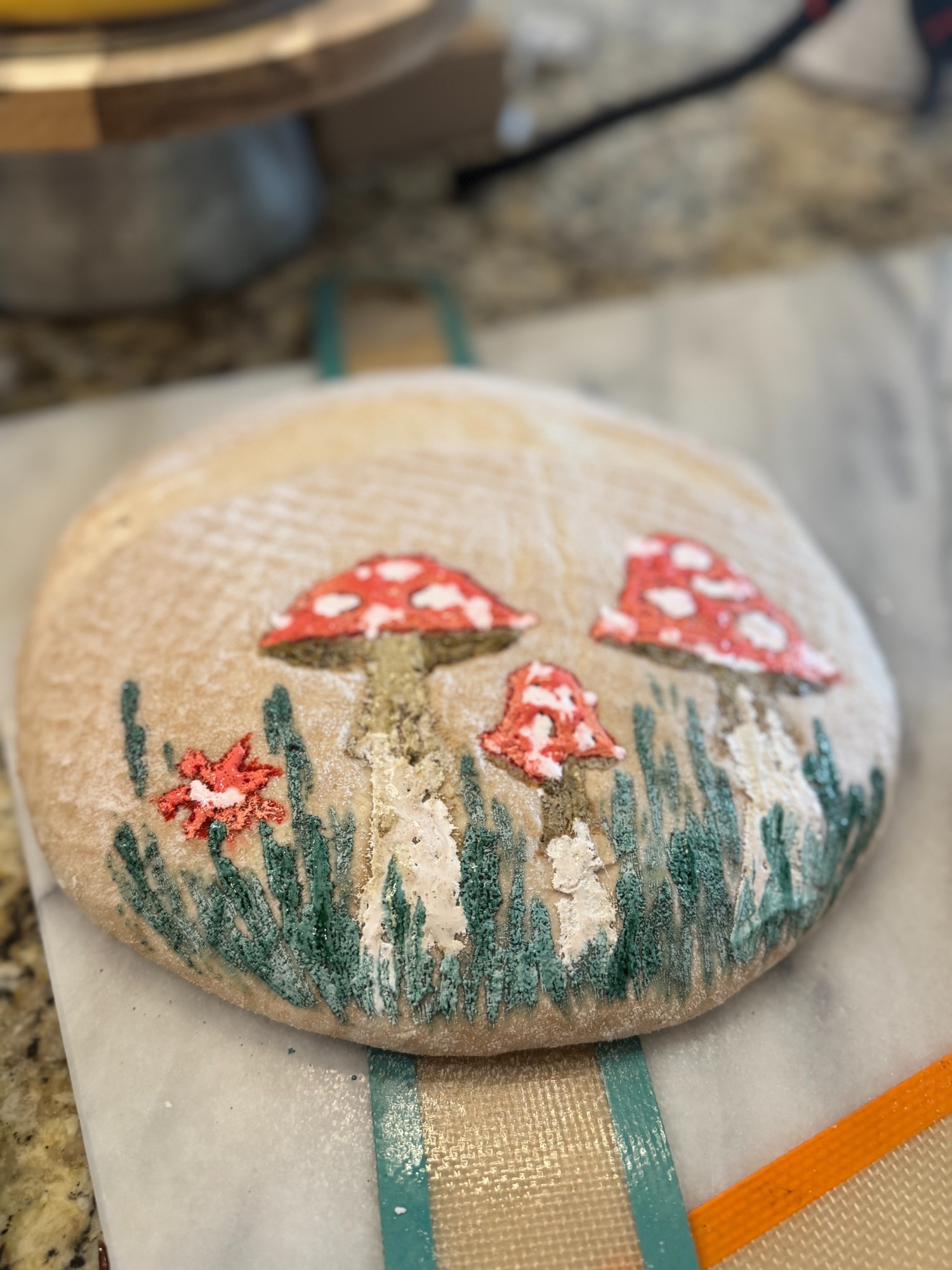
- Decorated boules (scored designs, stenciled flour patterns, ear designs) — these take meaningfully more time and produce a product people photograph before they eat. Price the skill. $22–$30 is appropriate for a visually striking specialty loaf.
- Croissants — laminated doughs are genuinely labor-intensive, require more expensive butter, and have a higher failure rate than simpler bakes. A croissant that takes 3 days to make should never be sold for $2.50. $5–$8 per croissant is appropriate and normal at artisan prices.
- Enriched loaves (brioche, milk bread, chocolate babka) — expensive butter and eggs, longer production time, and a product with strong gift-purchase potential. Price these at a minimum of $20–$28 for a full loaf.
- Seasonal specials — anything you make for a holiday, with a premium ingredient (high-grade chocolate, specialty fruit, truffle), or in limited quantity should be priced at the top of your range. Scarcity supports price.
Why Raising Prices Rarely Costs You Customers
This is the fear that keeps microbakers underpriced longest. And it deserves a direct, data-informed response.
When you raise prices on an artisan product, you typically lose one category of customer: price-sensitive buyers who were never your real audience to begin with. These are the people who bought your bread because it was cheap, not because they valued what you were making. Losing them is not a loss — it's a correction.
The customers you keep after a price increase are your actual customers: the people who value your product, your story, your consistency. They don't leave for a $2–$4 price increase. In many cases, they feel more confident about the quality because you're charging what excellent bread costs.
Real-world data from microbakers who have raised prices backs this up. The typical experience: a small number of complaints (mostly online, rarely in person), a brief dip in volume, and then a return to normal volume at the higher price. Revenue goes up. Hours stay the same or decrease as you bake fewer loaves for the same income.
The actual math: if you're selling 30 loaves a week at $10 and you raise to $15, you could lose 10 customers and still make the same revenue. And you'd be doing it in less time, with less flour, with less stress.
How to Announce a Price Increase
You don't owe anyone an explanation for charging a fair price. But if you've built a customer base at a lower price and want to raise it without drama, a simple, honest announcement works well.
The formula: brief acknowledgment of the change, honest reason, effective date, gratitude. Something like this:
Post it once on Instagram. Send it to your email list if you have one. Say it at the market. And then stop explaining. Confident bakers charge confident prices.
What "Charging What You're Worth" Actually Means
This phrase gets thrown around a lot in creative business communities, and it can feel vague or self-helpy. Let's make it concrete.
"Charging what you're worth" means: charging enough that your business can sustain itself and pay you a reasonable wage for your labor. That's it. It's not about ego or self-esteem. It's about building a business that doesn't require you to work for free.
Every hour you bake and sell at a price that doesn't cover your labor, you are subsidizing your customers' lunch. That is a choice you can make consciously — maybe you're building the business, building a following, and you're okay accepting below-market wages temporarily. But it should be a conscious choice with a timeline, not a permanent state of affairs disguised as humility.
"Charging what you're worth" means: doing the math, knowing your cost of goods, knowing your market rate, and setting a price that keeps you in business for the long run. That's good for you, good for your customers who value your product, and good for the artisan baking community as a whole.
The Worked Example: $8/Loaf vs. $16/Loaf
Let's compare two identical bakers — same product, same market, same 30 loaves per week — with different prices. Using the cost structure we built above (hard costs of $5.99/loaf, 36 minutes of active labor per loaf):
| Baker A — $8/loaf | Baker B — $16/loaf | |
|---|---|---|
| Weekly gross revenue (30 loaves) | $240 | $480 |
| Hard costs (30 x $5.99) | $179.70 | $179.70 |
| Revenue after hard costs | $60.30 | $300.30 |
| Active labor hours (30 x 36 min) | 18 hours | 18 hours |
| Effective hourly rate | $3.35/hr | $16.68/hr |
At $8/loaf, Baker A is earning $3.35 an hour. That is below minimum wage in every state in the country. It is also not actually $3.35 — it doesn't account for the time Baker A spends feeding starter, sourcing supplies, managing orders, or driving to the market. When all time is included, Baker A at $8/loaf is likely earning under $2/hour.
At $16/loaf, Baker B earns $16.68 an hour — before accounting for all the non-baking time. Still not wealthy, but approaching a wage that acknowledges the skill and time involved. And $16 is still below what many experienced microbakers charge in competitive markets.
The argument for $8/loaf is always "I'll sell more." Even if Baker A sells 60 loaves a week at $8 — double the volume, double the work — they gross $480, have the same $360 in hard costs for 60 loaves, and earn $120 for 36 hours of labor. That's $3.33/hour on twice the labor.
Volume doesn't fix a broken price. It makes the problem worse.
Setting Your Price: A Three-Step Process
You now have everything you need. Here's how to actually set your prices:
- Calculate your true cost per item. Use the framework above: ingredients + packaging + energy + allocated overhead (booth fee, processing fees, equipment) + your time at a minimum of $15–$20/hour. This is your cost floor.
- Research your market rate. Visit local markets, search Instagram, check artisan bakery prices in your area. Find the range. You should be pricing within it — on the higher end if your product is exceptional.
- Set a price that covers costs and pays you. If the market rate supports it — and in most cases it does — price at a level where you are earning at least $15/hour for your time after all costs. If the market won't support that, you need to either reduce costs (buy better flour in larger quantities, reduce packaging cost, fill your booth capacity) or find a different market where the rate is higher.
Do not negotiate yourself down before you've even posted the price. Do not assume customers will push back before they've had the chance not to. Set the price that makes the business sustainable. Then bake the best bread you can and let the product speak for itself.
"Set the price that makes the business sustainable. Then bake the best bread you can and let the product speak for itself."
Part 5 covers where to actually sell your bread — the pros and cons of every sales channel available to a cottage baker, and how to choose the right one for your situation, your schedule, and your growth goals.